 Hagwon Hub
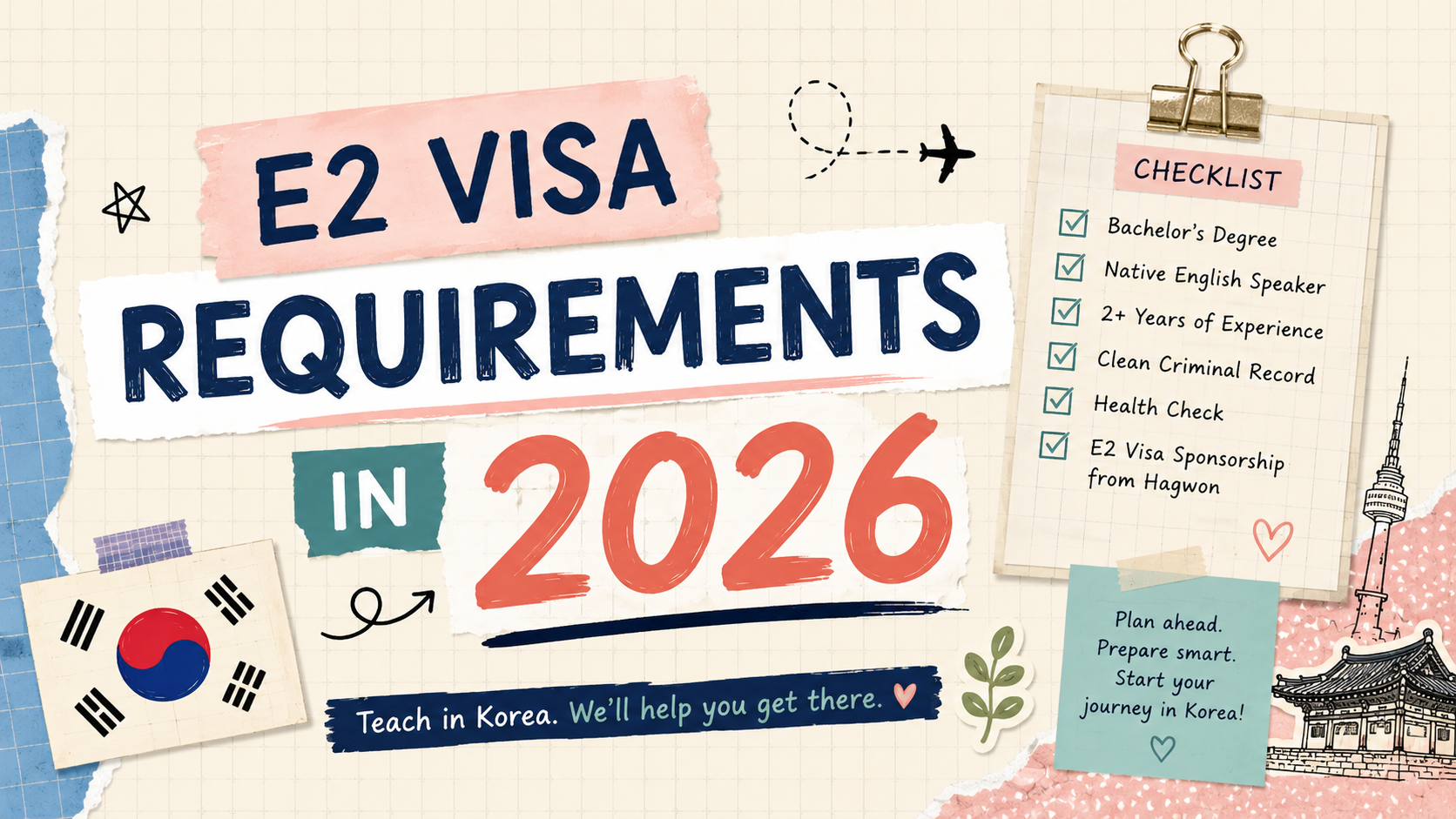
Dreaming of teaching English in the vibrant landscape of South Korea? It's a fantastic goal, but navigating the visa requirements can feel like deciphering a secret code. Forget the rumors and conflicting advice – we're cutting through the noise to give you the exact, official requirements to teach English in Korea on an E-2 visa, straight from Korean immigration.
The good news? The legal requirements are surprisingly straightforward. Many popular certifications and qualifications that people assume are mandatory are actually just employer preferences. Let's break down exactly what Korea requires, and what's just a bonus.
The E-2 Visa: Korea's Legal Requirements
The E-2 visa is Korea's 'conversation instructor' visa, specifically for teaching English. These requirements are set by Korean Immigration, not individual schools. This means every hagwon (private language academy), EPIK program (public school), and even international school must adhere to these fundamental rules.
1. Bachelor's Degree (Any Major)
- You need a four-year bachelor's degree from an accredited university.
- Your major doesn't matter – English, History, Engineering, Art, Business all qualify equally.
- The degree must be from one of the following countries: United States, United Kingdom, Canada, Australia, New Zealand, Ireland, or South Africa.
- Associates degrees, online-only degrees (with some exceptions), and three-year degrees generally do NOT qualify (exception: government-recognized three-year degrees from Canada, Australia, or UK may qualify).
- You cannot apply until you physically have your diploma. 'I graduate in May' doesn't work for initial application.
2. Citizenship from an English-Speaking Country
- You must be a passport holder from one of the seven qualifying countries listed above (USA, UK, Canada, Australia, New Zealand, Ireland, or South Africa).
- Permanent residents, green card holders, and long-term visa holders do NOT qualify based on residency alone.
- Dual citizens holding citizenship from a qualifying country can use that passport.
- Non-native English speakers from countries like France, Germany, Korea, Japan, China, Philippines, or India do NOT qualify for an E-2 visa, even with perfect English or a US degree. Citizenship is the deciding factor.
3. Clean Criminal Background Check
- You need a national-level background check (e.g., FBI for Americans, ACRO for UK, RCMP for Canadians) with an apostille stamp.
- The background check must be issued within 6 months of your visa application.
4. Clean Health Check
You'll undergo a health screening at a Korean hospital after your arrival. This screening typically includes:
- Chest X-ray (checking for TB)
- Blood test (checking for HIV, syphilis)
- Drug test (checking for marijuana, opioids, amphetamines)
- General physical examination
If you use prescribed medication, bring documentation from your doctor. ADHD medication and antidepressants are generally fine with proper paperwork. Marijuana users, beware: even if legal in your home country, THC can show in tests for 30+ days. Korea has a zero-tolerance policy. Stop at least 60 days before your health check.
Recommended But Not Required
While the above are legal prerequisites for the E-2 visa, these next items are highly recommended to make you a competitive applicant.
TEFL/TESOL Certification
- Legal requirement: None.
- Practical reality: Approximately 90% of employers, including EPIK and most hagwons, require or strongly prefer a 100–120 hour TEFL certification. You will find it very difficult to get hired without one.
- Qualifies: 100+ hour certification from any accredited provider (online accepted by most employers).
- Qualifies (stronger): CELTA or Trinity CertTESOL in-person certifications are highly regarded.
- Does NOT qualify: Certificates under 100 hours, 'weekend TEFL' courses, or non-accredited providers.
- Cost: $200–$400 for online, $1,500–$2,500 for in-person CELTA.
Teaching Experience
- Legal requirement: None.
- First-time teachers are regularly hired through both EPIK and hagwon programs.
- Experience can help for university positions (often require 2+ years) and international schools. It can also be a factor in negotiating a higher hagwon salary (e.g., an additional 200,000–400,000 KRW monthly).
Education Degree or Teaching License
- Legal requirement: None for hagwons or EPIK.
- These are only required for international schools. If you plan to teach internationally long-term, a teaching license is a valuable investment, but it's not necessary for a typical 1–2 year stint in Korea.
Do You Qualify? Decision Tree
You QUALIFY if:
- You are a US/UK/Canadian/Australian/NZ/Irish/South African citizen with a valid passport from that country.
- You possess a four-year bachelor's degree from an accredited university (any major, any field).
- You have no disqualifying criminal history (as outlined below).
- You are able to pass the Korean health screening.
Example: A Canadian citizen with a degree from any Canadian university, a clean RCMP background check, and who passes a health screening is fully qualified, regardless of where they currently live.
You DO NOT QUALIFY if:
- Your citizenship is from a non-qualifying country, even if you speak perfect English, hold a US degree, or lived in the USA for years.
- You hold only a US green card or permanent residency (not citizenship).
- You have only an associate's degree or a two-year degree (with the exception of recognized three-year UK/AUS degrees).
- You have a disqualifying criminal record.
Example: An Indian citizen with a Master's from Oxford does not qualify. A French citizen with a Columbia degree does not qualify. A Philippine citizen with a US green card does not qualify. Citizenship is the deciding factor, not degree location or English proficiency.
Special Cases and Exceptions
Online Degrees
Korean immigration doesn't explicitly ban online degrees, but many employers may reject them. Degrees from recognized online programs (e.g., Penn State World Campus, Arizona State Online) are more accepted. A potential issue is the apostille process, as some online providers might not issue apostille-eligible diplomas. If you have an online degree from a regionally accredited US university, you can try, but it's wise to have a backup plan.
Three-Year Degrees
- UK: Three-year bachelor's degrees from UK universities generally qualify, as this is the standard UK degree length.
- Australia: Three-year bachelor's degrees generally qualify.
- Canada: Three-year degrees may NOT qualify; a four-year bachelor's is strongly preferred.
Criminal Record: What Actually Disqualifies You
| Category | Examples | Outcome |
|---|---|---|
| Automatic disqualification | Child abuse, sexual offenses, drug trafficking, violent felonies | Cannot teach in Korea |
| Case-by-case | DUI/DWI, drug possession, theft, assault | Employer decides, disclose upfront |
| Generally acceptable | Traffic violations, old misdemeanors (10+ years, no repeat) | Usually fine |
Expunged records: Korea may still see them. Apostilled background checks often show everything on file, even if expunged in your state or province. Honesty is the best policy.
Documents You'll Actually Need
For Visa Application
- Passport (valid for 18+ months from your entry date)
- Bachelor's degree diploma (original or certified copy) with apostille
- University transcripts (official, sealed) with apostille
- National criminal background check with apostille (FBI / ACRO / RCMP)
- Passport photos (2–3 copies)
- Visa application form (provided by your employer)
- Employment contract (from your hagwon or EPIK)
- Health check results (completed in Korea after arrival)
Apostille Process
An apostille is a government authentication stamp that proves a document's legitimacy for international use. Notarization is NOT the same; Korea requires an apostille. The timeline can be 2–8 weeks depending on your country and state.
| Country | Where to Get | Timeline | Cost |
|---|---|---|---|
| USA | Secretary of State (in your degree's state) | 2–8 weeks | ~$10–50/doc |
| UK | Foreign, Commonwealth & Development Office (FCDO) | 2–4 weeks | ~£45 |
| Canada | Global Affairs Canada | 3–6 weeks | ~$100 CAD |
| Australia | Dept of Foreign Affairs and Trade | 2–4 weeks | Varies |
Background Check Process
| Country | Provider | Fingerprints? | Timeline | Cost |
|---|---|---|---|---|
| USA | FBI Identity History | Yes (police station or postal service) | 8–12 weeks | ~$50 |
| UK | ACRO Police Certificate | No | 10–15 business days | ~£45 |
| Canada | RCMP | Yes (police station) | 6–10 weeks | ~$100 CAD |
Pro-tip: Start your background check first! It's usually the slowest part of the process. An 8–12 week FBI check can significantly delay your entire timeline if you don't get a head start.
TEFL Certification: What You Need to Know
EPIK Requirements
- Minimum: 100 hours, from any accredited provider.
- Online TEFL is accepted by EPIK.
- Waived if you have a bachelor's or master's in Education, English, or Linguistics.
Recommended Providers
| Type | Providers | Cost | Best For |
|---|---|---|---|
| Budget online | International TEFL Academy, i-to-i TEFL, TEFLPros, Premier TEFL | $200–$400 | Most hagwon and EPIK positions |
| Premium in-person | CELTA (Cambridge), Trinity CertTESOL | $1,500–$2,500 | University jobs, competitive applications |
Do employers care about quality? Somewhat. A CELTA is more impressive than a generic online TEFL, but both will meet the 'TEFL required' checkbox. Unless you're targeting competitive university positions, an online TEFL is usually sufficient.
Age Limits and Restrictions
Minimum age: 18 (though most employers prefer 21+). Maximum age: no official immigration limit.
| Position | Practical Age Range | Notes |
|---|---|---|
| Hagwon | 22–45 typical | Age discrimination exists; 35–45 still hired regularly; 45+ faces more rejections |
| EPIK | 22–55 practical | Officially no maximum; over 55 is rare but possible |
| University | 28–60 | Least age discrimination; experience valued over youth |
If you're over 40, target EPIK or university positions as they tend to have less age discrimination. You might want to avoid hagwons focused on very young children, where parent preferences can skew younger.
Alternative Visa Options
F-Series Visas (Marriage, Family)
If you're married to a Korean citizen (F-6 visa) or have other Korean family ties (F-1, F-2 visas), you can teach English without needing to meet the specific E-2 requirements. This means no citizenship restriction, and the degree requirement may be more relaxed. However, you must qualify for the F-visa separately.
What You Cannot Do Without E-2 or F-Visa
- Private tutoring: Illegal on an E-2 visa, legal on an F-visa.
- Teaching at multiple schools simultaneously: Illegal on an E-2 (your visa ties you to one employer).
- Coming on a tourist visa to work: This is illegal and risky. Do not do this, regardless of what any recruiter might suggest.
Bottom line: If you don't meet E-2 requirements and don't have an F-visa, you cannot legally teach in Korea. Plan for 2–3 months from job offer to actually starting work due to document gathering and visa processing.
FAQ
I'm graduating in May. Can I apply now for August EPIK?
Yes. EPIK often allows applications before graduation if you provide a letter from your university confirming your expected graduation date. You must submit your final diploma before departure.
My degree is from a non-qualifying country but I'm a citizen of a qualifying country. Do I qualify?
Yes. Citizenship is the key factor. A US citizen with a degree from the University of the Philippines still qualifies, though some employers may scrutinize the degree's legitimacy more closely.
I have a DUI. Will I be rejected?
It depends on the employer. Some hagwons reject any criminal record. EPIK reviews cases individually. Always be honest on applications; lying and getting caught is worse than disclosing upfront.
Do I need to speak Korean to teach?
No. Most teachers start with zero Korean. Schools want you teaching in English only. Learning Korean helps with daily life but is not a job requirement.
Can I get an E-2 visa if I'm Korean-American with a US passport?
Yes, if you hold US citizenship and a US passport. Korean-Americans with US passports are fully eligible.
Can I teach at multiple schools on an E-2 visa?
No. An E-2 visa ties you to one employer (your visa sponsor). Working for a second employer simultaneously is illegal. If you change jobs, you must get your visa transferred to the new employer.
Is 35 too old to teach in Korea?
Not at all. EPIK and hagwons regularly hire teachers in their 30s and 40s. While some age discrimination exists, 35 is well within the normal hiring range.
Next Steps: Getting Qualified
If You Already Meet Requirements
- Get TEFL certification: A 100–120 hour online course takes 4–6 weeks ($200–$400).
- Request official transcripts from your university: Make sure they are sealed, takes 1–2 weeks.
- Order an apostille for your degree: This takes 2–8 weeks depending on your state/country.
- Apply for your background check: This is the longest step (8–12 weeks for FBI, faster for UK/Canada). Start this FIRST.
- Get your background check apostilled: Allow 2–4 weeks.
- Apply to EPIK or hagwons: You can start this process while your documents are being processed.
Total timeline: Expect 3–4 months from starting your documents to having everything ready. Remember, the background check is often the bottleneck, so prioritize it.
The Bottom Line
- Legal minimum: Bachelor's degree + qualifying citizenship + clean background check + pass health screening.
- Competitive minimum: All of the above + a 100–120 hour TEFL certification.
- Not required but helpful: Teaching experience, CELTA, education degree (especially for international schools).
If you meet the four legal requirements and get a basic online TEFL, you are qualified for 90% of ESL teaching jobs in Korea. The barrier is much lower than most people think. The most common mistake is overthinking it – thousands of first-time teachers with no prior experience get hired every year.
Last Updated: May 2026. Requirements occasionally change based on Korean immigration policy. For the most current rules, consult immigration.go.kr or your nearest Korean embassy. This guide is informational, and visa approval is ultimately at the discretion of Korean immigration.