 Hagwon Hub
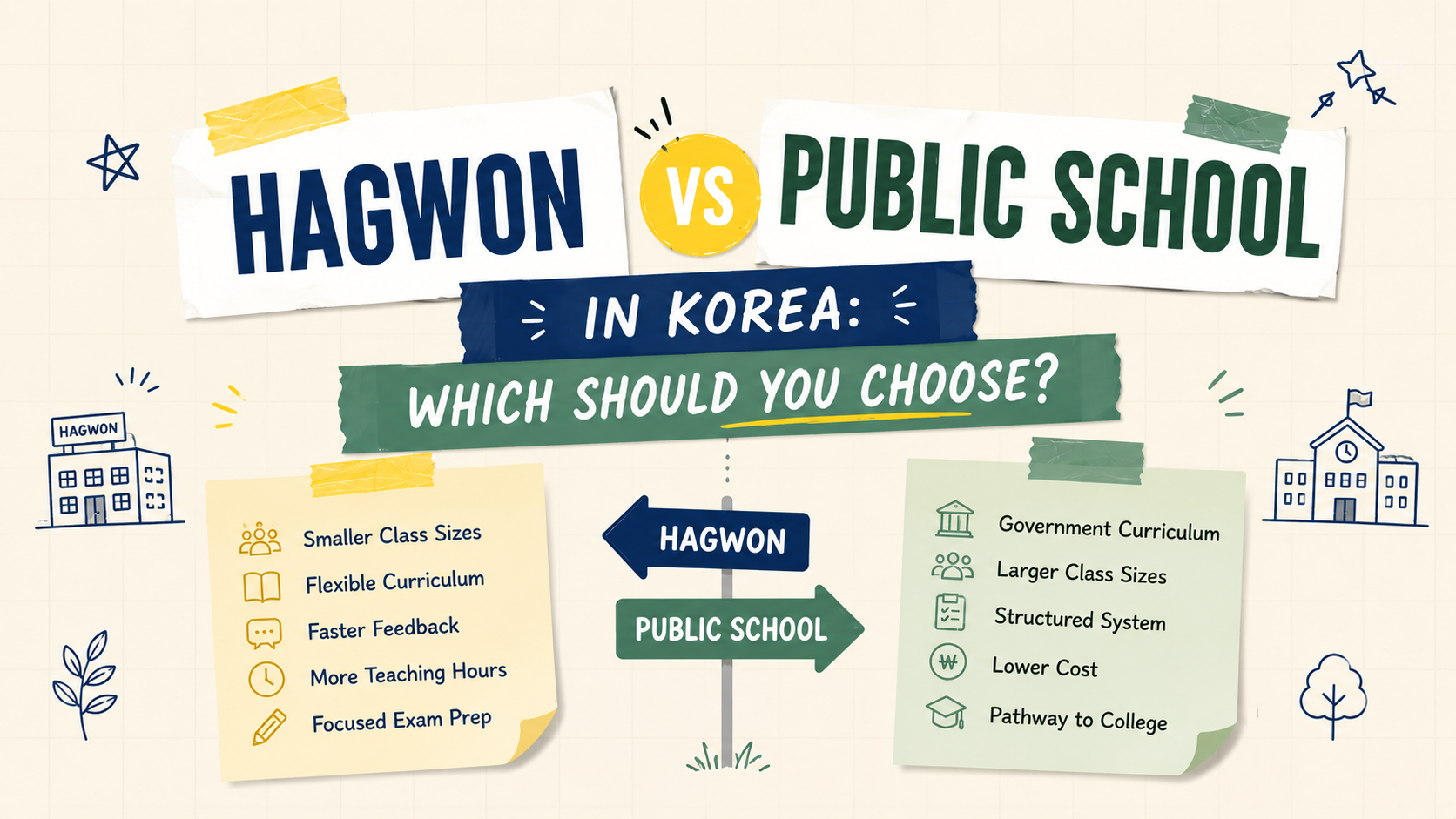
Deciding Between Public Schools and Hagwons: Your Korean Teaching Trade-Offs Laid Bare
Dreaming of teaching English in South Korea? You're faced with two primary paths: working in a public school through programs like EPIK (English Program in Korea) or teaching at a private language academy, known as a hagwon. Both offer incredible experiences, but they come with distinct trade-offs in terms of salary, lifestyle, and work environment. Before you sign any contract, let's break down every crucial difference so you can make the best decision for your future.
Quick Answer: Lifestyle vs. Savings & Location
Here's the essential takeaway:
- Public schools (EPIK) offer better work-life balance, more vacation (18+ days vs 10), and shorter teaching hours (22 hours/week vs 30–40).
- Hagwons offer higher monthly salaries (200,000–400,000 KRW more), faster hiring, and guaranteed city placement.
Choose public school for lifestyle and stability. Choose hagwon for maximum savings and location control.
Salary Comparison: Who Actually Pays More?
While hagwons often boast higher monthly figures, a deeper dive into annual compensation and hourly rates reveals a more nuanced picture.
Monthly Salary
| Experience Level | EPIK/Public School | Hagwon | Difference |
|---|---|---|---|
| First-year teacher | 2.0–2.3M KRW | 2.3–2.5M KRW | +200,000–400,000 KRW |
| 1–2 years experience | 2.1–2.4M KRW | 2.4–2.6M KRW | +300,000–400,000 KRW |
| 3+ years experience | 2.2–2.5M KRW | 2.5–2.7M KRW | +300,000–400,000 KRW |
On average, a hagwon pays 200,000–400,000 KRW (approximately $150–$300 USD) more per month, which translates to 2.4M–4.8M KRW ($1,800–$3,600 USD) more annually.
Total Year 1 Compensation
- EPIK (2.2M base): Approximately 31.2M KRW ($23,458 USD), including monthly salary × 12 + completion bonus + severance.
- Hagwon (2.5M base): Approximately 35M KRW ($26,316 USD), including monthly salary × 12 + completion bonus + severance.
The annual difference typically favors hagwons by about 3.8M KRW ($2,858 USD).
The Hourly Rate Reality
When you factor in the total hours worked, the picture shifts:
- EPIK: Approximately 15,000 KRW/hour (31.2M ÷ 2,080 estimated work hours).
- Hagwon: Approximately 13,461 KRW/hour (35M ÷ 2,600 estimated work hours).
Surprisingly, on an hourly basis, EPIK often pays more. Hagwons achieve higher annual totals by simply requiring you to work 500+ more hours per year.
Work Hours Reality Check
This is where the lifestyle differences truly emerge.
EPIK / Public School
- Teaching hours: 22 hours/week
- Total commitment: 30–40 hours/week (includes lesson preparation, desk warming, administrative tasks)
- Schedule: Typically 8:30am–4:30pm, Monday–Friday
- Evenings and weekends: Almost always free
EPIK offers a predictable 9-to-5 schedule, leaving your evenings free for Korean classes, hobbies, and socializing. "Desk warming" (sitting idle when no classes are scheduled) is a unique aspect; some teachers appreciate the paid downtime, while others find it draining.
Hagwon
- Teaching hours: 30–40 hours/week
- Total commitment: 40–50+ hours/week (includes prep, grading, parent communication)
- Schedule: Often 2pm–10pm, Monday–Friday, with some requiring Saturday shifts (e.g., 9am–3pm)
- Evenings and weekends: Largely consumed by work
At a hagwon, you often work when everyone else is off. Finishing at 10pm means friends back home are asleep, and local evening events are off-limits. While mornings are free, exhaustion can be a real factor, and your social life may narrow to other hagwon teachers on the same schedule.
Schedule Trade-Off
- EPIK advantage: Evening classes, concerts, and socializing are all possible. Video calls home after work. Weekend trips are easy to plan.
- Hagwon disadvantage: Most evening events are off the table. Significant time zone gap with your home country. Social circle can remain narrow.
Vacation Time: The Biggest Lifestyle Difference
For many, this is the deciding factor.
EPIK / Public School
- Paid vacation: 18 days/year
- School breaks: 3–4 weeks in winter + 3–4 weeks in summer (paid, but you are required to be available at school)
- Total: 18 true vacation days + approximately 6–8 weeks of low-activity school break time
During winter and summer breaks, you must still report to school or be available, even with no classes. Some schools require daily desk presence, while others allow flexible hours or remote work. In practice, most EPIK teachers use this break time to travel (combining vacation days with the low-duty period), study Korean intensively, or work on personal projects.
Hagwon
- Paid vacation: 10 days/year
- School breaks: None, hagwons operate year-round and run intensive programs when public schools are off.
- Total: 10 days + Korean public holidays (approximately 3–4 days)
- Vacation must be requested 60+ days in advance and usually cannot fall during summer/winter intensive seasons.
The Impact
- EPIK teachers: With 18 vacation days plus 6–8 weeks of reduced-workload time, you can realistically visit 8–12 countries during a year or two. There's ample time for intensive Korean study.
- Hagwon teachers: You're limited to a maximum of 3–4 short trips per year. Forget spending Christmas at home or taking month-long backpacking trips. You will be busiest during traditional vacation periods.
Teaching Environment and Classroom Autonomy
Your day-to-day experience will vary significantly depending on your role.
| Factor | EPIK / Public School | Hagwon |
|---|---|---|
| Your role | Co-teacher (always) | Sole teacher (except kindergarten) |
| Class size | 20–35 students | 8–15 students |
| Curriculum | Government textbook | Hagwon textbook (some flexibility) |
| Grading | Korean teacher handles most | You create tests, grade everything |
| Stress level | Low to Medium | Medium to High |
In EPIK, the co-teacher relationship defines your experience. When it works well, you have a real support system, shared responsibility, and built-in discipline backup. When it doesn't, you may feel micromanaged or find a co-teacher speaking Korean through your English lesson.
In a hagwon, you have full ownership: direct student relationships, no interference in elementary and middle school programs, and smaller classes. The flip side is that every complaint, grade dispute, and classroom problem lands entirely on you. Note: Kindergarten hagwons (ages 4–7) typically have Korean co-teachers, similar to EPIK. Elementary and above programs usually involve solo teaching.
Application Timeline and Hiring Process
Your urgency and preferences for location will heavily influence this.
| Factor | EPIK | Hagwon |
|---|---|---|
| Intakes | February + August only | Rolling year-round |
| Application to departure | 6–8 months | 1–3 months |
| Placement control | None (MOE assigns) | High (apply to specific city/neighborhood) |
| Acceptance rate | ~40–50% (competitive) | Varies (generally easier) |
EPIK works well if you're planning 6+ months in advance and can tolerate uncertainty regarding your placement location. A hagwon is ideal if you need to start soon or have a non-negotiable city requirement.
Location: Where You'll Actually Live
This can be a make-or-break factor for many applicants.
EPIK Placement
- Seoul: 15–20% of placements (highly competitive).
- Major cities: 30–35% (e.g., Busan, Daegu, Gwangju).
- Rural: 20–25% (can be beautifully immersive or somewhat isolating).
- You cannot choose your specific school or neighborhood; placements are assigned by the Ministry of Education (MOE).
Hagwon Placement
- You choose your exact city, often down to the neighborhood.
- Seoul jobs: 60–70% of all available hagwon positions.
- There's no lottery; you know your location before signing a contract.
Location control matters most if you have a partner already in Korea, require easy access to Incheon Airport, or simply can't imagine yourself in a rural placement. If you're genuinely open to living anywhere, EPIK's rural placements often deliver the most authentic and immersive Korean experience.
Who Should Choose Hagwon
Choose a hagwon if you:
- Prioritize maximum savings, where an extra $1,200–$1,300 annually truly matters.
- Need to start working within 1–3 months and can't wait for EPIK intake deadlines.
- Must live in Seoul or a specific, preferred city.
- Prefer smaller class sizes (8–15 students vs 20–35).
- Want full classroom autonomy without a co-teacher.
- Are okay with a 2pm–10pm schedule.
- Can handle solo responsibility for all classroom outcomes.
- Want to negotiate contract terms (salary, housing, schedule).
Don't choose a hagwon if you need extensive travel time, value evenings and weekends, desire a collaborative teaching environment, or need government-backed employment stability.
Who Should Choose Public School (EPIK)
Choose EPIK if you:
- Value work-life balance over extra income.
- Want 18+ vacation days and significant school break time.
- Prefer a 8:30am–4:30pm schedule with free evenings.
- Are okay with placement anywhere in Korea.
- Can plan 6–8 months ahead for intake deadlines.
- Want a co-teaching structure and shared responsibility.
- Want public school experience on your teaching resume.
- Prefer structured curriculum and government employment stability.
Don't choose EPIK if Seoul placement is non-negotiable, you need to start within 1–2 months, or you require maximum savings.
FAQ
Can I switch from hagwon to EPIK mid-year?
No. You must complete your current contract first. Breaking a contract results in the loss of all bonuses and can create visa complications. Choose carefully from the start.
Which is better for paying off student loans?
Hagwon edges out EPIK with approximately $1,200–$1,300 more annually, but the gap is modest. Both options work for loans under $25,000. For $40,000+ debt, neither option competes with teaching opportunities in the Middle East or China.
- EPIK: Approximately $800/month payment = paid off in ~20 months.
- Hagwon: Approximately $900/month payment = paid off in ~18 months.
The difference is roughly 2 months faster with a hagwon.
Which is better for learning Korean?
EPIK provides more free time for evening classes and intensive study during school breaks. Rural EPIK placements often necessitate daily Korean use. Hagwons offer more parent interaction and morning time if you wake early. Both paths can work, but EPIK generally provides more dedicated time, while hagwon might create more necessity through interaction.
Can I teach at a hagwon part-time while doing EPIK?
No. This strictly violates E-2 visa terms. Consequences can include visa cancellation, deportation, a permanent ban from Korea, and the loss of all bonuses. It is never worth the risk.
What if I'm still not sure which is right for me?
Consider these questions to help clarify your priorities:
- Can I wait 6–8 months to depart? Yes = EPIK possible. No = hagwon only.
- Must I be in Seoul? Yes = hagwon. Open to anywhere = EPIK.
- What's more valuable: $1,200 extra annually or 8 extra vacation weeks? Money = hagwon. Time = EPIK.
- Do I prefer support or autonomy in the classroom? Support = EPIK. Autonomy = hagwon.
- Do I need evenings free? Yes = EPIK. No = hagwon.
Safe choice: EPIK (better work-life balance, lower burnout risk). Aggressive choice: Hagwon (higher savings, potentially higher stress).
Final Thoughts
Neither a public school position through EPIK nor a hagwon job is objectively "better." Both paths will get you to Korea with a livable salary, free housing, and an incredible cultural immersion experience. EPIK generally wins on time, job security, and collaborative teaching. Hagwon generally wins on take-home pay, speed of hiring, and location control. Choose the option that aligns with your actual priorities and lifestyle preferences, not just what online forums might suggest.
Last Updated: May 2026. Data from EPIK salary schedules, 183 hagwon teacher surveys (Jan–Apr 2026), and r/EPIK + r/teachinginkorea community reports. Exchange rate: 1,330 KRW = 1 USD.