 Hagwon Hub
Category: Life in Korea | Reading time: ~18 minutes | Last updated: August 2026
Disclaimer: This guide is for general informational purposes only and does not constitute legal, financial, immigration, or medical advice. Holiday dates, substitute holiday designations, transport reservation windows, toll policies, store operating hours, and delivery service suspensions change every year and are set by different operators. Every date, fare, fee, and hour referenced below is illustrative and should be confirmed with the relevant operator, retailer, or government source before travel plans are made. Employment entitlements around public holidays depend on individual contract terms and current labour law.
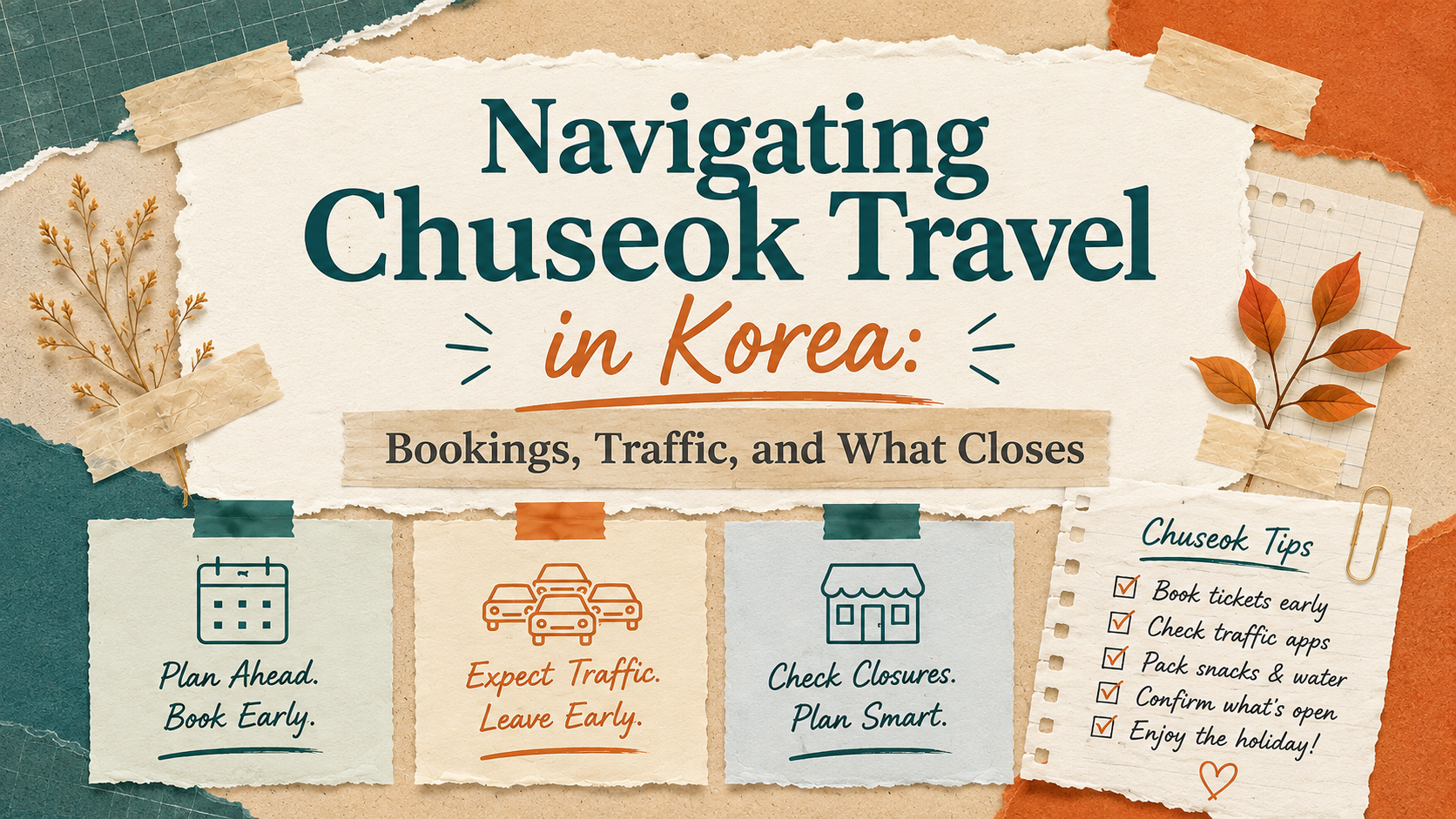
This guide covers: when Chuseok 2026 falls and how long the shutdown really lasts, how and when to book trains, buses, flights, and rental cars, what the traffic actually does and which departure windows avoid it, which services stop working for several days, how each of the four major convenience store chains behaves over the holiday and what each one can still do for a traveller, and what to do instead if travelling turns out to be the wrong call.
When is Chuseok 2026 and how long does everything close?
Short answer: Chuseok follows the lunar calendar and falls in late September 2026. The official public holiday runs three days: the day before Chuseok, Chuseok itself, and the day after. When one of those days lands on a weekend, Korea's substitute holiday system usually adds a weekday, which can stretch the period to four or five consecutive days.
That last point drives everything else in this guide. A three-day Chuseok and a five-day Chuseok are different events. A longer break spreads departures across more days and softens peak traffic, but it also extends the window during which banks, clinics, government offices, and delivery networks are unavailable.
Verify this first. Confirm the exact 2026 dates and whether a substitute holiday has been designated before booking anything. The designation is announced by the government and is not always obvious from a calendar app set to a foreign locale. Korean calendar apps and the Naver calendar mark substitute holidays clearly in red.
What Chuseok actually is
Chuseok is a harvest festival centred on family and ancestral remembrance. Households travel to a hometown, often the paternal family home, to share food and observe ancestral rites. It is frequently described in English as Korean Thanksgiving, which captures the family-gathering element and the scale of domestic travel but misses the ancestral component entirely.
For a foreign resident, the cultural detail matters less than the logistical consequence: a very large share of the population moves across the country within roughly a 48-hour window, and then moves back.
Do teachers at private academies get the full holiday?
Short answer: Public holidays are not automatically paid days off at every workplace, and entitlement depends on contract wording and current labour law provisions on statutory holidays. Some academies close for the full designated period, some close for the calendar days only and skip any substitute holiday, and some run a reduced schedule.
This is worth clarifying in writing well before booking non-refundable travel. A contract clause reading "national holidays" is not the same as "public holidays as designated by the government including substitute holidays." Ask which specific dates the academy will be closed, and get the answer in a message rather than a corridor conversation.
Should you travel during Chuseok at all?
Short answer: Travel within Korea during Chuseok costs more time than distance suggests, and the alternatives are unusually good. Travelling makes sense for a fixed commitment such as visiting friends, a booked festival, or a flight already purchased. It rarely makes sense for a spontaneous domestic trip, because the same trip in mid-October takes half the time at a lower price.
Three honest questions before committing.
- Is the destination somewhere Koreans go for Chuseok, or somewhere they leave?
Traffic flows toward regional hometowns and away from the Seoul metropolitan area. A trip that runs against that flow is dramatically easier than one that runs with it. - Is the accommodation confirmed and refundable?
Popular destinations sell out weeks ahead. Anything still available at short notice is either expensive, remote, or both. - Is there a hard reason to move during the holiday specifically?
If the answer is "the days are free," consider that most of Korea's cities empty out during Chuseok. Seoul during Chuseok is one of the few times the city is genuinely quiet.
How to book transport for Chuseok
Reservations for major holiday transport do not open on a normal rolling schedule. Operators run a dedicated advance-sale window, usually around a month before the holiday, and inventory is released all at once.
Train reservations: KTX and SRT
Korea's two high-speed operators run separate booking systems with separate inventory. A seat sold out on one may still exist on the other, on a route both serve.
| Item | KTX | SRT |
|---|---|---|
| Operator | Korail (state operator) | SR (separate operator) |
| Booking channel | Korail app and website, stations, phone | SRT app and website, stations, phone |
| Main Seoul terminus | Seoul Station, Yongsan | Suseo (south-east Seoul) |
| Holiday advance sale | Dedicated window roughly a month ahead | Dedicated window roughly a month ahead |
| Foreign card acceptance | Varies by payment page and card | Varies by payment page and card |
How the holiday sale works, in order:
- The operator announces the advance-sale dates several weeks beforehand.
- Sales open online first, typically in the early morning, split across days by route or direction.
- Remaining inventory goes to station counters and phone booking afterwards.
- Seats for the highest-demand departures are gone within minutes.
- Standing tickets, where offered, are released separately and sell more slowly.
- Cancellations return to inventory continuously right up to departure.
The cancellation window is the real opportunity. Most people who miss the initial sale give up. Cancellation penalties increase as departure approaches, which pushes a wave of cancellations into the final few days. Checking the app repeatedly during the two days before travel, and again on the morning of, produces seats far more often than most travellers expect.
Set up the payment method before the sale opens, not during it. Registering a card, completing identity verification, and confirming the app login all take longer than the inventory lasts. The most common reason for missing a seat is not slow selection, it is a verification screen appearing at checkout.
Express and intercity buses
Buses are the underrated option. Capacity is more elastic than rail because operators add extra services for the holiday, and reservations open on a longer runway with less of a stampede.
The trade-off is exposure to road traffic. A bus and a car sit in the same jam. On a normal weekend a bus to a regional city may be only marginally slower than the train. On the peak Chuseok departure day it can take twice as long or worse.
Two separate networks exist, and this catches people out:
- Express buses (고속버스) run long-distance point to point on expressways, from express bus terminals, with one integrated national booking system.
- Intercity buses (시외버스) cover shorter and more granular routes with more stops, from intercity terminals, on a different booking system.
Some cities have both terminals in different locations. Confirm which terminal a ticket departs from before travelling to it.
Domestic flights
Domestic aviation is dominated by routes to Jeju, which behave differently from everything else. Jeju is a destination rather than a hometown, so demand there is leisure demand, and it surges during any long break.
Expect fares well above baseline, limited availability, and unusually punishing cancellation terms on the cheapest fare classes. Flights from Gimpo, which is closer to central Seoul, sell out before flights from Incheon.
Weather risk is real on Jeju. Late September still falls within the typhoon season window. A cancelled Jeju flight during a holiday period is difficult to rebook because every subsequent flight is already full. Travel insurance and a flexible fare class are worth more here than on any other domestic route.
Rental cars
Rental availability during Chuseok is tight and pricing is seasonal. Two things to confirm before booking:
Licence validity. Driving in Korea on a foreign licence generally requires either an International Driving Permit issued under the relevant convention, or a Korean licence obtained by conversion. Rules differ by issuing country, and some nationalities are not covered by the IDP arrangement Korea recognises. Verify status with the relevant authority well before the holiday, not at the rental counter.
Insurance scope. Understand the excess, what the basic waiver covers, and whether a second driver is registered. Holiday traffic produces low-speed collisions in queues, and unregistered drivers void coverage.
Chuseok traffic: what actually happens on the roads
Short answer: Expressway journey times during peak Chuseok departure and return windows commonly run to roughly double the normal duration, and on the worst corridors considerably more. The pattern is highly predictable: outbound from the capital region on the day before Chuseok, inbound back to it on the day after.
The predictability is the useful part. This is not random congestion. It is the same flow, in the same direction, at roughly the same hours, every year.
The directional pattern
| Phase | Timing | Heavy direction | Light direction |
|---|---|---|---|
| Outbound peak | Morning of the day before Chuseok | Capital region toward south and east | Toward the capital region |
| Holiday lull | Chuseok day itself, midday onward | Local movement only | Long-distance largely clear |
| Return peak | Afternoon of the day after Chuseok | Regions toward the capital region | Away from the capital region |
| Tail | Final day, evening | Late returns, moderate | Clear |
Departure windows that work
Leave before dawn. Departing between roughly 3am and 5am on the peak day consistently beats departing at 8am by hours, not minutes. This is the single highest-value adjustment available.
Or leave the night before the peak. Overnight departure trades sleep for a clear road, and arriving early morning at a family home is more socially normal in Korea than it might be elsewhere.
Return on Chuseok day itself rather than the day after. Traditional obligations are concentrated on the morning of Chuseok. Travelling back that same afternoon puts a vehicle on the road ahead of the main return wave.
Avoid the first day of the holiday between roughly 7am and 2pm outbound, and the final travel day between roughly 1pm and 9pm inbound. These are the windows that produce the headline journey times.
Live traffic data
Korean navigation apps carry expressway congestion overlays and estimated journey times that update continuously, and they are considerably more accurate inside Korea than international mapping alternatives, which cannot access the underlying domestic road data. The expressway operator also publishes forecast journey times between major city pairs for each holiday day in advance, which is more useful for planning than a live map.
For why international map apps underperform inside Korea and which navigation apps to install instead, see the guide to essential Korean apps.
Expressway tolls
Korea has, in recent years, waived expressway tolls for the designated Chuseok holiday days. This is announced separately each year and should not be assumed. Vehicles without an electronic toll transponder still pass through the appropriate lane and are processed accordingly. Verify the current year's policy before travel.
Rest stops
Expressway rest areas remain open and become the pressure point of the entire journey. Expect long queues for food and for toilets, full car parks, and a meaningful delay simply re-entering the traffic flow on departure.
Practical adjustments: stop at a smaller rest area rather than a famous one, stop off-peak rather than at conventional meal times, and carry water and food in the vehicle so a stop is optional rather than mandatory. Fuel before the holiday begins, because the busiest rest area fuel stations develop queues of their own.
What stops working during Chuseok
This is the section most foreign residents wish they had read earlier. The holiday is not simply a period when offices are closed. Several systems that operate continuously the rest of the year pause entirely, and a few of them matter.
| Service | Status during the holiday | What to do instead |
|---|---|---|
| Banks (branches) | Closed for the full designated period | Withdraw cash beforehand; ATMs remain live |
| Parcel and courier delivery | Collection and delivery suspended for several days | Ship well before the cut-off, or wait |
| Food delivery apps | Operating but heavily reduced, with fewer open restaurants and longer waits | Check the app rather than assuming |
| Government offices | Closed | Nothing time-critical can be resolved |
| Immigration offices | Closed | Do not schedule appointments adjacent to the holiday |
| Post offices | Closed | Any deadline falls after the holiday |
| Clinics and dentists | Largely closed | Emergency departments operate throughout |
| Pharmacies | Many closed, some rotating duty pharmacies open | Use the official emergency medical portal to locate an open one |
| Large supermarkets | Reduced hours, some full-day closures | Convenience stores, covered below |
| Traditional markets | Extremely busy before, closed during | Buy early |
| Subway and city buses | Holiday timetable, typically the Sunday schedule | Allow longer waits; check last-train times |
| Taxis | Available but scarce at peak times | Book through an app well ahead |
| Waste collection | Suspended and rescheduled | Check the district notice before putting bags out |
The delivery suspension is the one that catches people out
Courier networks stop moving parcels for several days around Chuseok, and the backlog produces delays for several days afterwards on top of the closure itself. The cut-off for guaranteed pre-holiday arrival is typically announced by carriers around a week to ten days before the holiday, and online sellers post their own, earlier cut-offs.
Anything needed during or immediately after the holiday should be ordered roughly two weeks ahead. This includes medication refills, contact lenses, and anything ordered from overseas, where customs processing adds further delay.
Medical care during the holiday
Hospital emergency departments operate continuously. Ordinary clinics do not. Korea designates rotating duty pharmacies and duty clinics across the holiday period, and the official emergency medical information portal lists which facilities are open, searchable by area and time.
Before the holiday: refill any regular prescription, and confirm any dose that would run out. A prescription cannot be filled at a closed pharmacy, and an emergency department is a poor and expensive substitute for a routine refill.
Emergency services are reached on 119 for fire, ambulance, and rescue, and 112 for police. Both operate throughout the holiday, and interpretation support is available.
For how national health insurance coverage works and what a clinic visit actually costs, see the healthcare guide for foreign residents.
Cash
Bank branches close. ATMs stay live, but two problems appear. First, machines in high-traffic locations run out of notes and are not restocked on schedule during the holiday. Second, foreign card acceptance at ATMs is inconsistent, and the subset of machines that reliably accept overseas-issued cards is smaller than the subset that accepts domestic cards.
Withdraw before the holiday. Cash matters more than usual during Chuseok because some smaller regional businesses, market stalls, and rural establishments operate cash-only, and because transit card top-ups at a counter generally require cash.
Convenience stores during Chuseok: what stays open and what each chain can do
Convenience stores are the infrastructure that keeps working when the rest of the retail network stops. During Chuseok they stop being a place to buy a snack and become the practical substitute for a supermarket, a bank branch, a post office, and a ticket counter.
Understanding the differences between the four major chains is worth more during this week than at any other point in the year.
Are Korean convenience stores open during Chuseok?
Short answer: Most are, but not all, and not necessarily around the clock. Korean convenience stores are overwhelmingly franchise-operated, and operating hours are set at store level rather than nationally. A store that runs 24 hours in a business district will usually stay open through Chuseok. A store in a residential neighbourhood, run by an owner who travels for the holiday, may close for a day or reduce hours without warning.
Stores in and around transport infrastructure are the most reliable: stations, terminals, airports, hospitals, and expressway rest areas. These locations are staffed on the assumption of holiday traffic.
Check hours in the chain's own app rather than a general map listing. Holiday hours are frequently updated in the operator's app and rarely reflected in third-party listings until after the fact.
The four major chains, and what distinguishes them
Korea's convenience store market is dominated by four networks, each owned by a different retail group. Ministop, formerly a fifth network, was absorbed into the 7-Eleven network, so its former locations now operate under that brand.
| Chain | Operator group | Membership app | Notable holiday-relevant capability |
|---|---|---|---|
| CU | BGF Retail | Pocket CU | Broad parcel network via a major national courier, dense rural coverage |
| GS25 | GS Retail | Our Neighbourhood GS25 | Store-to-store half-price parcel service, item-storage feature for promotions |
| 7-Eleven | Korea Seven (Lotte) | L.POINT | Group courier integration, absorbed Ministop footprint |
| Emart24 | Shinsegae | Shinsegae Point | Franchise model with flexible hours, so 24-hour operation is less standard |
CU. The largest or joint-largest network by store count, with unusually strong coverage in smaller cities and rural areas. That matters during Chuseok specifically, because a trip to a regional hometown often ends somewhere a large supermarket does not exist. CU's parcel service runs through a major national courier network, which is convenient outside the holiday and irrelevant during it, since the courier itself pauses.
GS25. Comparable in scale and generally strongest in the capital region. Two features stand out. The store-to-store parcel service moves an item between GS25 branches at a much lower price than a standard courier, using the chain's own logistics rather than a courier network. The app's item-storage feature lets the bonus unit of a two-for-one or three-for-two promotion be saved and collected later at any branch, which is useful when buying holiday travel supplies in one place and collecting elsewhere.
7-Eleven. Operating under Korea Seven within the Lotte group, and now carrying the former Ministop locations. Loyalty runs on the group-wide points scheme rather than a chain-specific one, which means points accumulate across a much wider set of retailers and are worth tracking if that group's cards or affiliates are already in use.
Emart24. The smallest of the four and structurally different. Its franchise model was built around lower fees and greater owner discretion over opening hours, which means a materially larger share of its stores do not run 24 hours by default. During a holiday period, an Emart24 is the least safe assumption of the four for a 2am arrival.
Store counts across all four networks run to the tens of thousands nationally and shift constantly. Treat any specific figure as approximate and verify before publishing or relying on it.
What a convenience store can do for a traveller during Chuseok
This is the practical list. Several of these are unavailable or degraded during the holiday, and knowing which is which prevents a wasted trip.
- Cash withdrawal. Most stores host an ATM. Fees are higher than a bank machine, foreign card acceptance varies by machine operator rather than by chain, and machines run dry during holidays. Withdraw earlier and in a larger amount than feels necessary.
- Transit card top-up. Top-ups are handled at the counter and generally require cash, not card. A transit card with a low balance and a wallet with no cash is a common and avoidable Chuseok morning problem.
- Prepared food when everything else is shut. The prepared food category, meaning lunch boxes, rice rolls, sandwiches, and instant noodles, is the fallback when restaurants close. Hot water, microwaves, and seating are standard. Note that delivery of fresh stock is itself disrupted over the holiday, so shelves in smaller stores thin out and are not always replenished daily.
- Small holiday gift sets. Convenience stores stock compact holiday gift sets in the run-up to Chuseok. These are the last-minute option once department store and supermarket gifting sections have been cleared out. Useful if a host gift is needed and there is no time to shop properly.
- Parcel services, with a hard caveat. Both the courier-based services and GS25's store-to-store service pause during the holiday period. Drop-off may still be physically accepted at some stores, but the item does not move until collections resume, and the post-holiday backlog adds further delay. Anything time-sensitive must be sent before the announced cut-off.
- Bill payment and prepaid top-ups. Utility bill payment and mobile prepaid top-ups are available through in-store terminals. Availability of specific services varies by machine and by store.
- Ticket collection. Some stores support collection or printing of tickets and vouchers booked online through certain platforms. This varies enough by chain and store that it should be confirmed at booking rather than assumed on the day.
- Discounts, which still apply during the holiday. Membership app barcodes, in-app coupons, and card benefits all function normally over Chuseok. Holiday spending at convenience stores is higher than usual precisely because the alternatives are closed, which makes it the week the stacking is worth the most.
For how to stack membership points, in-app coupons, card benefits, subscription passes, and closing-time markdowns on a single purchase, see the full convenience store discount guide.
The holiday surcharge, and how to spot it
Some 24-hour convenience stores apply a small holiday or overnight surcharge, which must be disclosed on a notice displayed in the store. It is neither universal nor hidden, but it is easy to miss when scanning a receipt quickly.
If a total looks higher than expected during the holiday, check the receipt against the shelf price and look for the posted notice near the counter or door. This is not an error to dispute, it is a disclosed pricing policy applied at store level.
What runs out first
Stock replenishment slows across the holiday because the distribution network is also running a reduced schedule. In practice, the categories that empty first are prepared meals and fresh items, bottled water and soft drinks near transport hubs, and phone charging cables and battery packs at stations and terminals.
Rest area stores on the outbound expressway route are stripped earliest on the peak departure day. Buying travel supplies before setting off is meaningfully cheaper and more reliable than buying them at a rest stop three hours in.
A Chuseok travel timeline
Counting backward from the first holiday day.
| When | Action |
|---|---|
| Six weeks before | Confirm in writing which exact dates the academy is closed |
| One month before | Train advance-sale window opens; be registered and verified in the app in advance |
| Three to four weeks before | Book accommodation; book domestic flights if travelling to Jeju |
| Two weeks before | Order anything needed during the holiday, including prescriptions and contact lenses |
| Ten days before | Check the announced courier cut-off date for outgoing parcels |
| One week before | Refill prescriptions; confirm rental car licence requirements |
| Three days before | Withdraw cash; top up the transit card; fuel the vehicle |
| Two days before | Check cancellation inventory for any train seat still needed |
| Day before departure | Check forecast journey times published by the expressway operator |
| Departure morning | Leave before dawn, or accept the queue |
If you decide not to travel
Staying put during Chuseok is a legitimate and frequently better choice, and it produces a version of Korea that most residents rarely see.
Cities empty out. The capital region loses a substantial share of its population to regional travel. Streets, parks, and normally overcrowded neighbourhoods become quiet. Restaurants that require queuing all year become walk-in.
Palaces and cultural sites often open free of charge. Major palaces and cultural institutions have historically waived admission during Chuseok and run holiday programming. Confirm the current year's arrangements before travelling across the city for it.
Book anything that is open, early. The subset of restaurants that stay open during the holiday absorbs all the demand from residents who did not travel. Popular ones fill up.
Stock the fridge before it starts. Large supermarkets close or reduce hours, traditional markets close outright, and convenience store shelves thin out. A single shop three days beforehand removes the problem entirely.
Expect an invitation, and consider accepting it. Colleagues sometimes invite foreign staff who are not travelling to join a family gathering. Accepting is a meaningful gesture. Bring a gift, arrive on time, and follow the host's lead on the rites rather than participating uninvited.
Frequently asked questions
When is Chuseok 2026?
Chuseok falls in late September 2026, following the lunar calendar rather than a fixed date. The public holiday spans the day before Chuseok, the day itself, and the day after, with a substitute weekday sometimes added when the period overlaps a weekend. Confirm the exact designated dates before booking travel.
How far in advance do Chuseok train tickets go on sale?
Roughly a month before the holiday, through a dedicated advance-sale window rather than the normal rolling booking schedule. KTX and SRT operate separate systems with separate inventory, so a sold-out route on one may still have seats on the other.
What happens if all the trains are sold out?
Three options remain. Check cancellation inventory repeatedly in the final two days before travel, when penalties push a wave of cancellations back into the system. Book an express bus, which has more elastic capacity but is exposed to road traffic. Or shift the travel day away from the peak, which frees up availability immediately.
How much longer does driving take during Chuseok?
Peak departure and return windows commonly produce journey times around double the normal duration, and worse on the heaviest corridors. Departing before dawn on the peak day, or returning on Chuseok afternoon rather than the following day, avoids most of it.
Are expressway tolls free during Chuseok?
Tolls have been waived for the designated holiday days in recent years, but this is announced annually and should not be assumed. Verify the current year's policy before travelling.
Are convenience stores open during Chuseok?
Most are, but hours are set by individual franchise owners rather than nationally, so some reduce hours or close for a day. Stores at stations, terminals, hospitals, airports, and expressway rest areas are the most reliable. Emart24 has the largest share of stores that do not operate 24 hours by default.
Can parcels be sent during Chuseok?
No. Courier collection and delivery are suspended for several days, and the store-to-store convenience store parcel services pause as well. Carriers announce a pre-holiday cut-off date, typically around a week to ten days beforehand, and a backlog delays deliveries for several days after the holiday ends.
Are banks and ATMs available during Chuseok?
Bank branches close for the full designated period. ATMs continue operating, but machines in busy locations run out of cash and are not restocked on the usual schedule, and foreign card acceptance varies by machine. Withdrawing cash before the holiday begins is the reliable approach.
What happens if you get sick during Chuseok?
Hospital emergency departments operate continuously. Ordinary clinics largely close, and Korea designates rotating duty pharmacies and duty clinics across the holiday, listed on the official emergency medical portal with search by area. Emergency services are reached on 119. Any regular prescription should be refilled before the holiday starts.
Do public transport timetables change during Chuseok?
Yes. Subway and city bus networks typically run a holiday timetable, which usually corresponds to the Sunday schedule. Services are less frequent and last departures may be earlier than on a weekday, which matters for anyone returning to a station late.
Are academy teachers entitled to the full Chuseok holiday?
It depends on contract wording and current statutory holiday provisions. Some academies close for the entire designated period including any substitute holiday, others close only for the calendar holiday days. Confirming the specific dates in writing well before booking non-refundable travel avoids the most common and most expensive misunderstanding.
Is it better to travel or stay in the city during Chuseok?
For most foreign residents without a fixed commitment elsewhere, staying is the better experience. Domestic travel costs several hours of queuing in each direction and a price premium, while cities become unusually quiet, major cultural sites frequently open free of charge, and normally impossible restaurants become walk-in.
The short version
Chuseok is predictable, which is the whole advantage. The same flow happens in the same direction at the same hours every year, so the adjustments that work are known in advance: book train tickets the day the advance sale opens, work the cancellation window if that fails, leave before dawn on the peak day, and return on Chuseok afternoon rather than the day after.
The failures are equally predictable. Parcels stop moving for several days. Banks close and ATMs empty. Clinics and pharmacies mostly shut. Anything ordered late does not arrive.
Convenience stores absorb most of the gap, but not all of it, and not uniformly across the four chains. Cash withdrawn early, a prescription refilled in advance, and a transit card topped up before the holiday starts remove nearly every practical problem the week produces.
Pre-publication verification queue
| Item | Source to check |
|---|---|
| Exact Chuseok 2026 dates and substitute holiday designation | Government public holiday announcement |
| KTX and SRT holiday advance-sale dates and process | Korail and SR official notices |
| Expressway toll waiver policy for 2026 | Expressway operator announcement |
| Courier pre-holiday cut-off dates | Individual carrier notices |
| Duty pharmacy and duty clinic portal name and access method | National emergency medical information portal |
| Convenience store chain ownership, app names, and parcel service branding | Each operator's official site |
| Whether the holiday surcharge practice remains current and how it is disclosed | Retailer notice requirements |
| Statutory holiday entitlement provisions as they apply to private academies | Ministry of Employment and Labour |
| International Driving Permit recognition by nationality | Korean National Police Agency licensing authority |