 Hagwon Hub
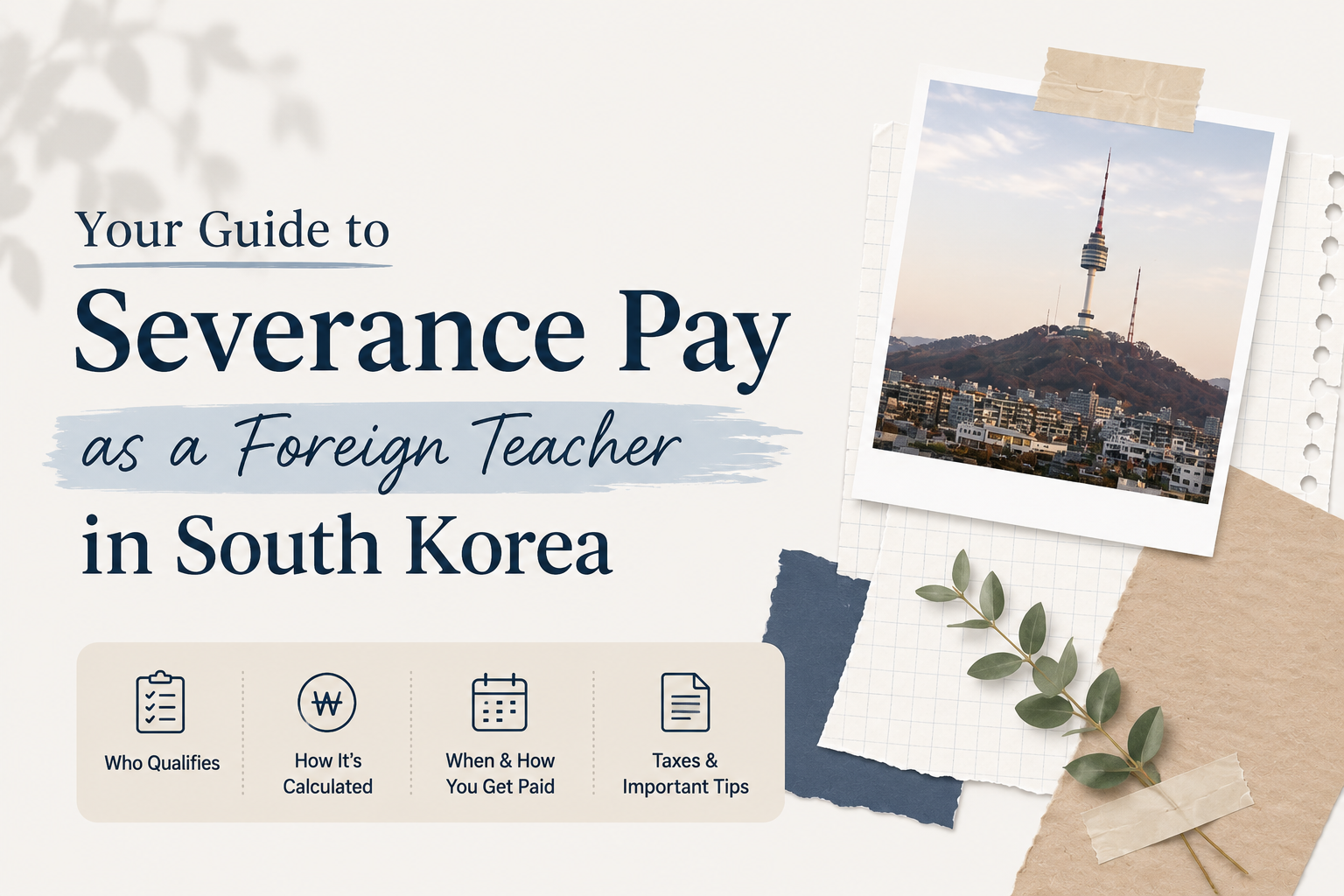
Understanding Your Rights: Severance Pay and Pension in Korea
Working as a foreign teacher in South Korea offers incredible experiences, but it’s crucial to understand your legal rights regarding benefits like severance pay and national pension. These aren't just perks; they are fundamental protections under Korean law, applicable to all employees regardless of their nationality or visa type. This guide will walk you through the essentials, from legal foundations to practical calculations and what to do if things go wrong.
Section 1: The Legal Basis of Severance Pay
Severance pay, known as 퇴직금 (toe-jik-geum) in Korean, is a mandatory benefit enshrined in the Korean Labor Standards Act (KLSA). This vital piece of legislation ensures that employees who complete a minimum period of continuous employment are compensated upon their departure.
The core entitlement states that any employee who completes 12 months of continuous employment with the same employer is entitled to severance pay. This amount is legally mandated to be equivalent to approximately one month's average salary for each year of service. The 'average salary' is calculated based on specific criteria, which we'll delve into in the next section.
A critical point to remember is the payment deadline: employers are legally obliged to pay severance within 14 days of the employee's last working day. Any delay beyond this period is a violation of the KLSA and can lead to penalties for the employer.
Furthermore, it’s imperative to understand that severance pay is a universal right under Korean labor law. This means it applies to you regardless of your nationality, the type of visa you hold (E-2, D-4, F-series, etc.), or the specific terms of your initial contract. It is not an immigration benefit or a discretionary bonus; it is a fundamental labor protection designed to provide a safety net for employees transitioning out of their roles. Claims by employers that foreigners are not eligible, or that it's 'included' in your monthly pay without clear legal justification, are often red flags.
Section 2: How Severance Pay is Actually Calculated
Understanding the exact calculation of your severance pay can demystify the process and ensure you receive your rightful amount. The Korean Labor Standards Act specifies a precise method for calculating the 'average salary' upon which severance is based.
The average salary is calculated using your total wages earned over the last three calendar months of your employment, divided by the total number of days in that three-month period. It's important to note that 'wages' for this calculation include not just your base salary but also certain regular allowances, bonuses, and other payments that are part of your regular remuneration. However, irregular or one-off payments might be excluded.
Once the average daily wage is determined, your severance pay is calculated using the formula: Average Daily Wage × 30 days × Number of Years of Continuous Service.
Let's walk through an example to illustrate this:
- Scenario: A teacher has a monthly salary of ₩2,400,000 and has completed 2 years of continuous employment.
- Step 1: Calculate total wages over the last 3 months.
If your monthly salary is consistently ₩2,400,000, then ₩2,400,000 × 3 months = ₩7,200,000. - Step 2: Determine the number of days in the last 3 months.
Assuming the last three months were, for example, July (31 days), August (31 days), and September (30 days), the total would be 92 days. - Step 3: Calculate the average daily wage.
₩7,200,000 / 92 days = approximately ₩78,260.87 per day. - Step 4: Calculate the severance pay for one year of service.
₩78,260.87 (average daily wage) × 30 days = ₩2,347,826.10. - Step 5: Calculate total severance pay for the period of employment.
Since the teacher worked for 2 years, the total severance pay would be ₩2,347,826.10 × 2 years = ₩4,695,652.20.
This example clearly shows how one month's 'average salary' for severance purposes is derived. It’s important to keep track of your pay stubs and any changes in your salary or regular allowances, as these will impact your final severance calculation.
Section 3: What Happens With Early Termination
The 12-month continuous employment threshold is key, but what happens if your employment period doesn't fit neatly into full years, or if your contract ends prematurely?
First, it's critical to understand that the right to severance pay *accrues* from the 12-month mark. If you work for less than one full year, you are generally not entitled to severance pay. However, once you pass the 12-month threshold, your entitlement begins, and it is calculated proportionally for any additional period.
For instance, if you complete 1 year and 6 months of continuous employment, your severance pay will be calculated for 1.5 years. The same logic applies if you work for 2 years and 3 months; you would be entitled to 2.25 years of severance.
The distinction between who terminates the contract — the school (employer) or the teacher (employee) — often causes confusion, but under Korean labor law, it typically does not affect your right to severance pay *once you have completed 12 months of continuous service*. As long as you have met the minimum continuous employment period, you are entitled to severance, whether you resign or your employer terminates your contract (barring certain specific disciplinary grounds for termination, which are rare for foreign teachers and subject to strict legal scrutiny).
However, if you voluntarily resign *before* completing the initial 12 months, you forfeit any right to severance. Similarly, if the school terminates your contract *before* you reach the 12-month mark, you will not be eligible for severance pay. The 12-month continuous service is the absolute baseline for establishing eligibility.
Always review your contract for clauses related to early termination and severance. While some contracts may attempt to limit or deny severance in specific termination scenarios, these clauses are generally unenforceable if they contradict the KLSA. Your statutory rights under the KLSA prevail.
Section 4: The 2026 Pension Layer and What It Means for You
Beyond severance, another significant financial consideration for foreign workers in South Korea is the National Pension Service (NPS). The NPS is a social security system designed to provide financial stability in retirement. As an employee in Korea, you and your employer typically contribute to this fund.
A significant reform to the National Pension Service is anticipated for 2026. This reform is expected to adjust the contribution rates, which are currently 9% of your standard monthly income, split equally between the employee and the employer (4.5% each). Following the 2026 reform, the total contribution rate is projected to increase to 9.5%, with the employee contributing 4.75% and the employer contributing 4.75%.
While this might seem like a deduction from your pay, for many foreign nationals from countries with reciprocal agreements with Korea, you are eligible to claim back your portion of the National Pension contributions when you leave the country permanently. This offers a substantial sum that can be reclaimed, often providing a welcome financial boost upon your departure.
The process to claim your NPS contributions back after leaving Korea involves several steps, including submitting an application form, providing proof of departure, and having a designated bank account. Navigating this can be complex, but comprehensive guides are available. For a detailed, step-by-step process on how to claim your NPS contributions, please refer to our dedicated blog post on 'Claiming Your National Pension Service Contributions Upon Leaving Korea'.
Understanding your NPS contributions and eligibility for a lump-sum refund is crucial for maximizing your financial benefits during and after your time in Korea. Ensure you keep records of your contributions and understand the application process well in advance of your departure.
Section 5: Red Flags and What to Do If It's Missing From Your Contract
When reviewing potential employment contracts, it’s crucial to be vigilant about how severance pay is addressed, or if it’s addressed at all. Unfortunately, some employers, particularly in the hagwon (private academy) sector, may attempt to sidestep their legal obligations.
Here are some common red flags to look out for:
- No mention of severance pay: If your contract makes no reference to severance, it doesn't mean you're not entitled to it; it's a legal right. However, its omission is a concern.
- 'Severance included in salary': This is a common, and usually illegal, tactic. Severance pay cannot be included as part of your monthly salary in advance. It must be paid as a lump sum upon completion of continuous service.
- Clauses requiring specific actions to 'qualify' for severance: While basic eligibility (12 months continuous service) is standard, any additional, unusual conditions may be unlawful.
If you encounter these red flags or suspect your contract is not compliant, here are actionable steps you can take:
- Clarify with the Employer: Politely but firmly inquire about severance pay, referencing the Korean Labor Standards Act. Ask for explicit clarification in writing.
- Consult Legal Aid: Organizations like the Seoul Global Center or the Ministry of Employment and Labor (MOEL) offer free consultation services for foreign workers on labor law issues.
- File a Complaint with the Labor Board: If your employer refuses to comply, you can file a complaint with the regional labor office of the Ministry of Employment and Labor. They will investigate and mediate.
- Document Everything: Keep records of your contract, pay slips, work hours, and any communication with your employer regarding severance.
At Hagwon Hub, we understand the importance of secure employment. You should know your rights, giving you peace of mind.
Conclusion: Empowering Your Journey in Korea
Navigating the intricacies of severance pay and national pension in South Korea can seem daunting, but armed with the right knowledge, you can protect your rights and ensure a smooth financial transition during and after your time here. Remember, these are not discretionary benefits; they are your legal entitlements as an employee under Korean law.
Understanding your severance calculation, the pension system, and recognizing potential red flags in contracts are crucial steps toward a secure and rewarding experience. Don't hesitate to seek clarification or assistance if you suspect your rights are not being upheld. Your time in Korea should be enriching, both professionally and personally, and being informed about your labor rights is a significant part of that.